QGATE SYSTEMS

Quantum Error Mitigation at the Edge.

Closing the 7-orders-of-magnitude latency gap. From cloud seconds, to 72 ns on-FPGA, to 20–40 ns on bare-metal ASIC.

Every number labeled Measured on hardware RTL-Synth cycle-accurate silicon model Projected extrapolated from measured upstream Target design goal

Cloud mitigation is bound by internet latency.

Today's stack runs in seconds — qubits decohere in microseconds. To break the coherence wall, mitigation must move to the edge: onto FPGAs (Quantum Machines OPX+) and, ultimately, cryogenic ASICs co-located with the QPU. Each tier closes the latency gap by an order of magnitude and unlocks chemical-accuracy simulation on today's NISQ hardware.

  • From 14 mEh Measured to 0.01 mEh Projected NISQ accuracy 14 mEh: NMC-111 cathode at 30q on ibm_marrakesh. 0.01 mEh: ASIC-tier projection.
  • From 67× Measured to 300–600× Projected error reduction vs. ZNE 67× on ibm_fez (Run 21). Multipliers stack as the firmware moves closer to the qubit.
  • Mid-circuit feedforward correction measured at 72 ns Measured OPX+ offline-compiled predictor-corrector loop — portable to live OPX+ with FPGA access.

Numbers That Speak.

98.5%
Error Reduction on IBM Heron Measured
156-qubit Heron-class QPU (ibm_fez), 270-gate circuit past the coherence cliff. Native ZNE flatlined; QGate recovered the signal.
60%
QPU Cost Saved Measured (Sim)
1.64× lower MAE on a noisy 9-qubit grid — Qiskit Aer with the device thermal-noise model. Same engine, fewer shots.
72 ns
Mid-Circuit Feedforward Measured
200-iteration predictor-corrector loop on a real OPX+ (offline compile). Inside the qubit's coherence window.
80.2%
Level-0 Bandwidth Headroom RTL-Synth
Deterministic temporal windowing on the raw ADC stream. 396 ns critical path inside a 2 µs readout pulse.

Performance multipliers by integration tier.

Each tier moves QGate closer to the qubit. Cloud middleware ships today. FPGA edge integration with Quantum Machines lands inside 12–24 months. The cryogenic ASIC end-game collapses control loops to tens of nanoseconds at microwatt-scale power.

Metric Cloudtoday OPX+ Level‑112 months OPX+ Level‑024 months ASIC at 4 K36–48 months
Feedback Latency seconds Measured 396 ns RTL-Synth 84 ns RTL-Synth 20–40 ns Projected
Effective Coherence (T) on TLS baseline 1.5–3× Projected 2–4× Projected 3–5× Projected
Error Reduction (vs. ZNE) 67× Measured 150–300× Projected 300–600× Projected order of magnitude further Projected
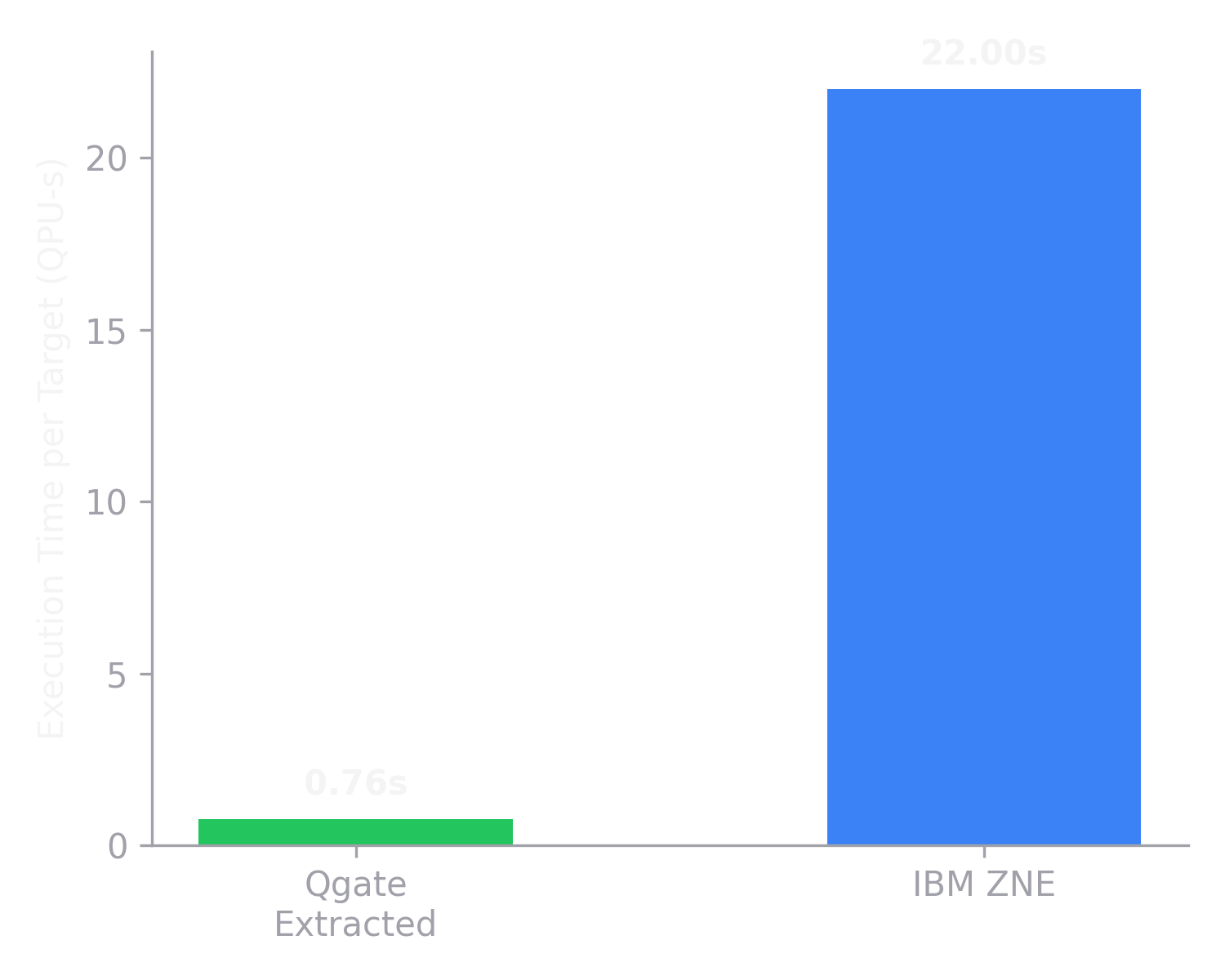
QPU Billable Time / Result 250 s Measured ~125 s Projected ~80 s Projected <30 s Projected
NISQ Accuracy 14 mEh Measured 0.2 mEh Projected 0.05 mEh Projected 0.01 mEh Projected
Power at 4 K Stage 0.66 mW RTL-Synth 0.66 mW RTL-Synth 30–100 µW Projected
Per-Controller BOM $5–8K market $5–8K market $80–250 Target
Deployable at 10 mK mixing chamber no no yes Target <20 µW design

ZNE = Zero-Noise Extrapolation. TLS = Two-Level System defects. mEh = milli-Hartree. Measured claims are anchored to test IDs in our internal inventory (Run 21 / Tests 9, 31, 33, 35, 37, 46).
From the FPGA edge to cryogenic silicon.

Our patented mitigation engine is portable across the full quantum control stack — from today's classical middleware to bare-metal ASICs inside the dilution fridge.

Stage 1 · Quantum Machines OPX+

The FPGA Edge.

Mid-circuit feedforward correction at 72 ns on a real OPX+ Measured — offline-compiled predictor-corrector loop.

  • 84 ns RTL critical path RTL-Synth Artix-7 timing closure on the QJL pipeline. 580 LUTs, no DSP slices.
  • Level‑0 80.2% bandwidth savings RTL-Synth Native access to unintegrated ADC waveforms inside a 2 µs readout window.
  • ~0.2 mEh chemistry accuracy Projected Mid-circuit re-anchoring extends usable depth past the coherence wall.
  • 5–15× logical-qubit multiplier Projected Temporal redundancy from raw ADC samples — no spatial QEC overhead.
Stage 2 · The Endgame

The Cryogenic ASIC.

XNOR-popcount silicon seated inside the dilution fridge. 20–40 ns latency Projected — standard FPGA→ASIC ratio on a fully-pipelined datapath.

  • 30–100 µW at 4 K Projected From the measured 0.66 mW Artix-7 floor at 4 K.
  • <20 µW for 10 mK deployment Target Mixing-chamber stage budget. No competing architecture has this path.
  • $80–250 per-controller BOM Target 28 nm tape-out economics at 100k units.
  • 0.05–0.1 mm² silicon per qubit Projected From measured 580 LUTs / qubit on Artix-7 (1.44% utilization at 156q).

Breaking the decoherence wall.

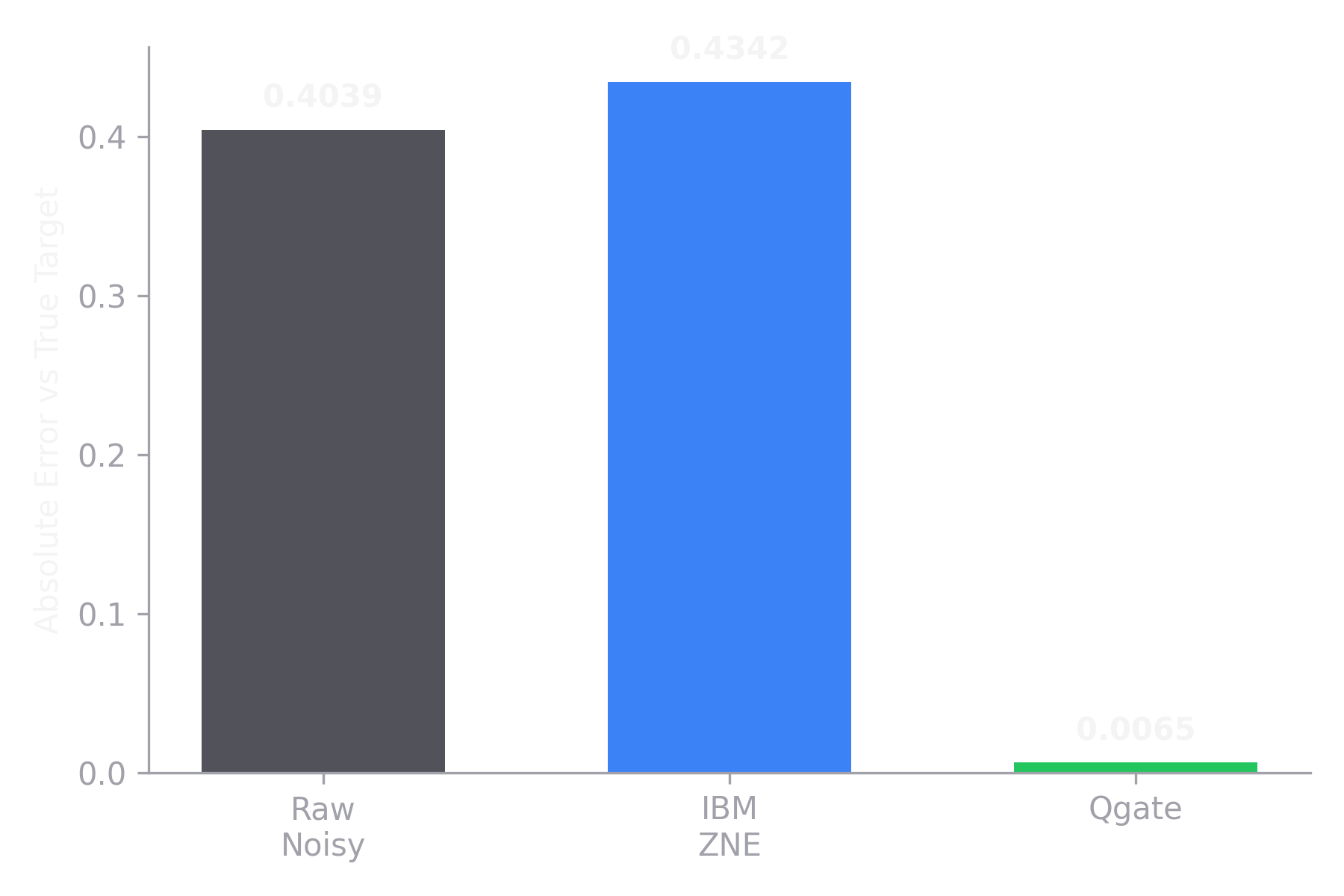
A 270-gate time-evolution circuit on ibm_fez (156-qubit Heron-class) — pushed past its coherence cliff. Native ZNE flatlined. QGate recovered the signal at 98.5% lower error — one shot, single job ID d7pmfrc3lfgs73fg5cq0 (Run 21).

Metric Native Mitigation QGate Middleware
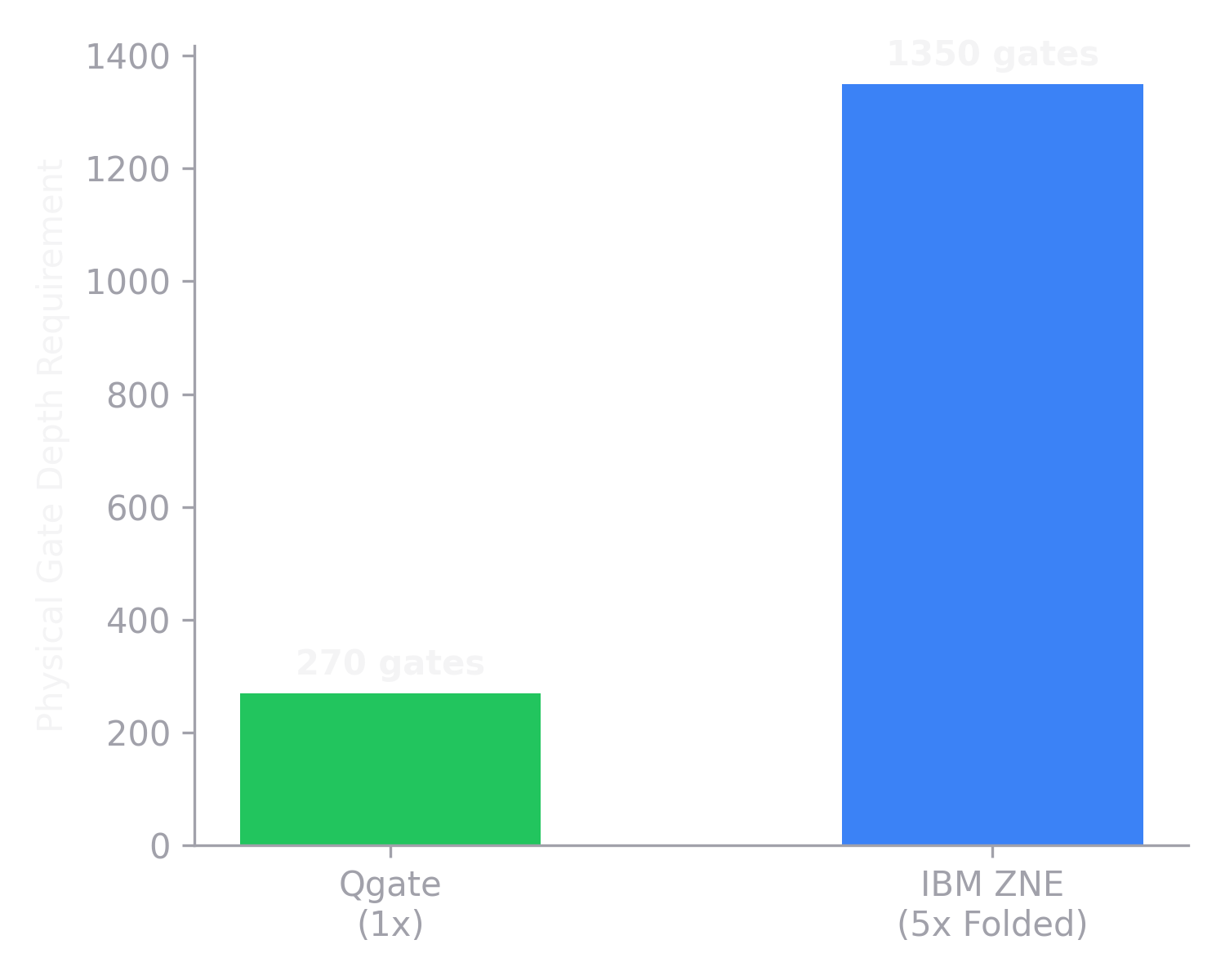
Physical Depth Required Amplified (810 – 1,350 gates) Measured Baseline (270 gates) Measured
Hardware State Thermal Collapse (Flatline) Measured Signal Recovered Measured
Absolute Error 0.4342 Measured 0.0065 (67× / 98.5%) Measured
Scaling Overhead (TTS) Exponential Measured Bounded / Constant Measured
Physical Depth Required: Amplified vs Baseline
Absolute Error: Native Mitigation vs QGate Middleware
Scaling Time to Solution (TTS): Exponential vs Constant

Built for the leading hardware stacks.

Validated on IBM heavy-hex (Torino, Heron). Architected for Quantum Machines edge controllers (OPX+/OPX1000). On-roadmap to cryogenic ASIC. Talk to us about hardware integration, deployment, or seed/Series A investment.

Expanded graph data